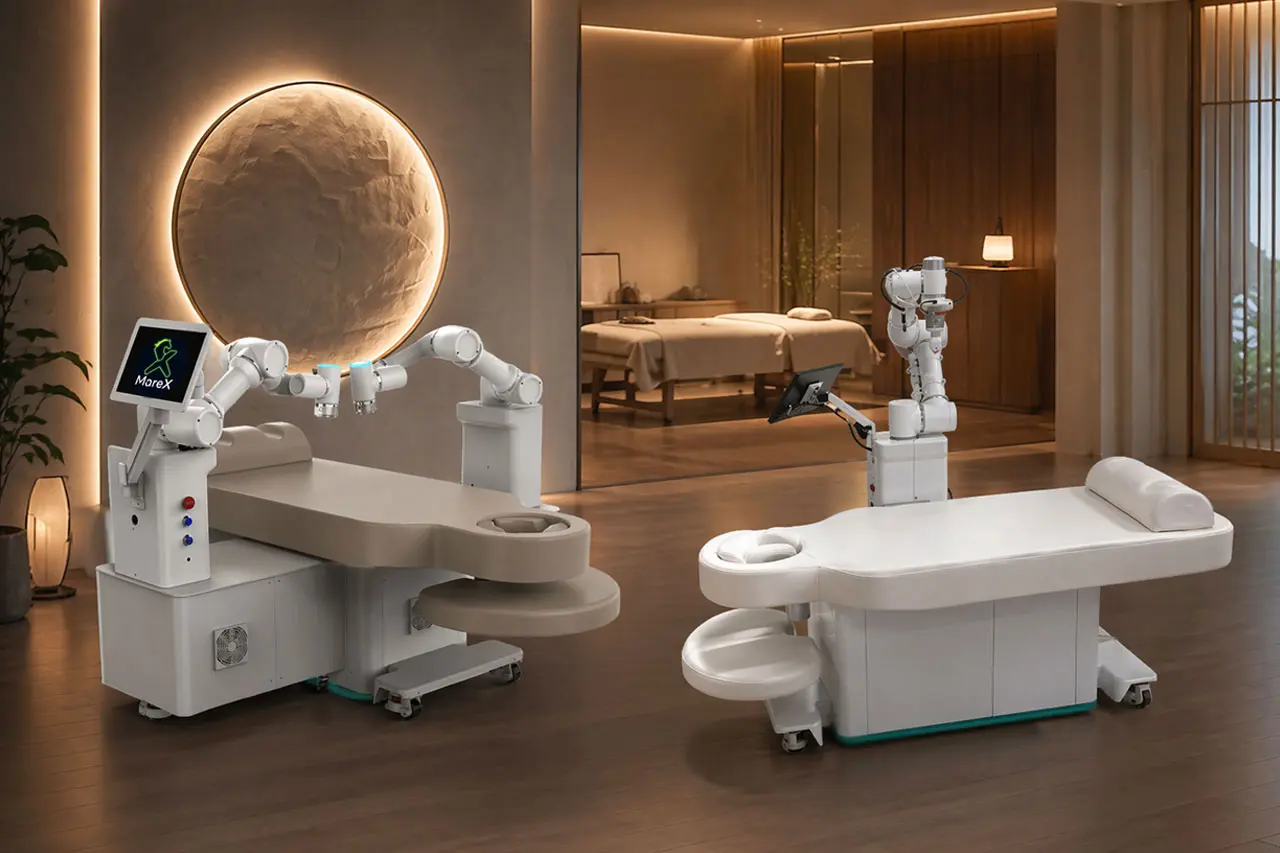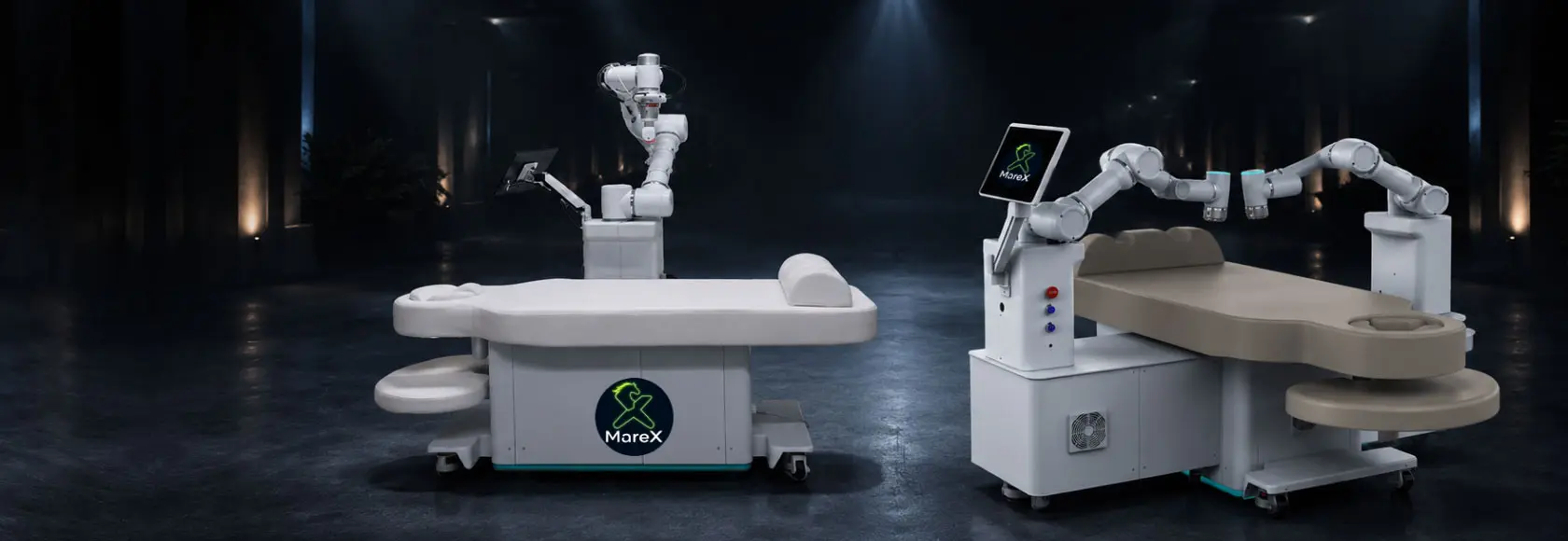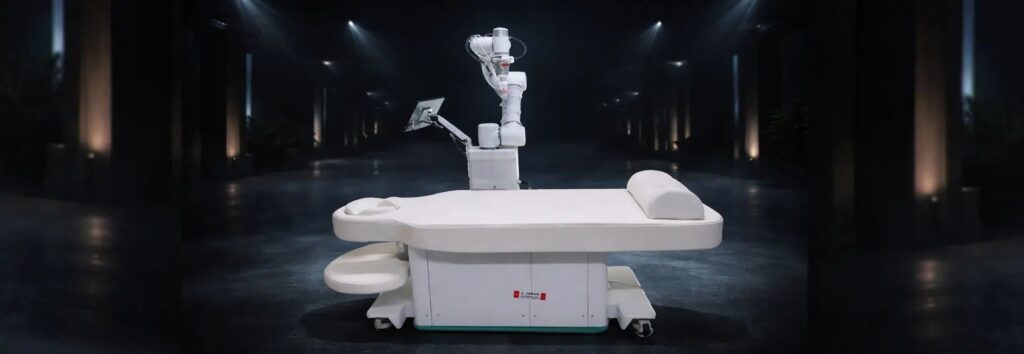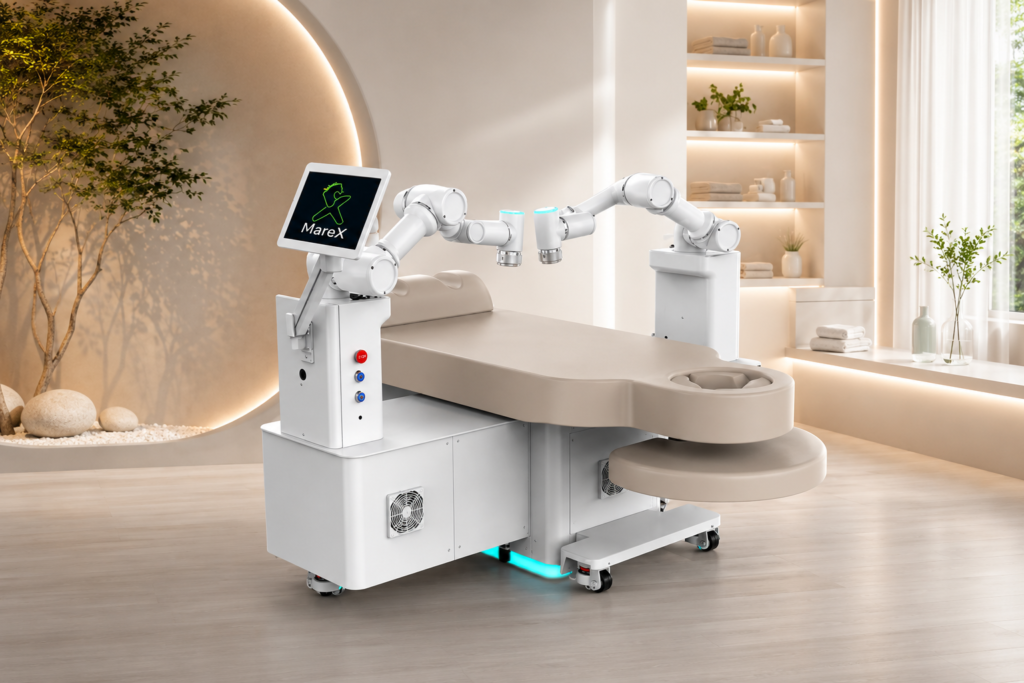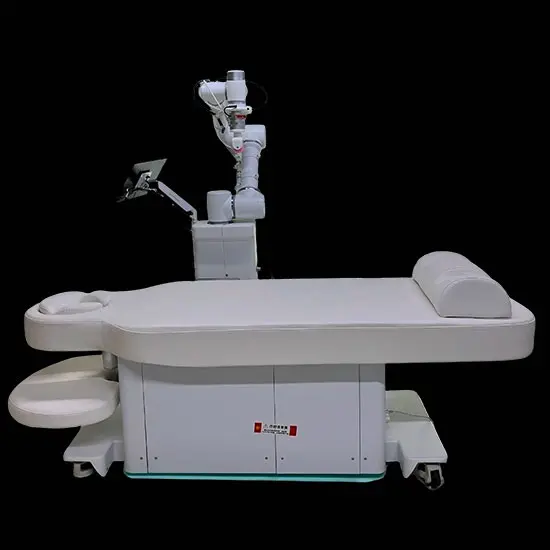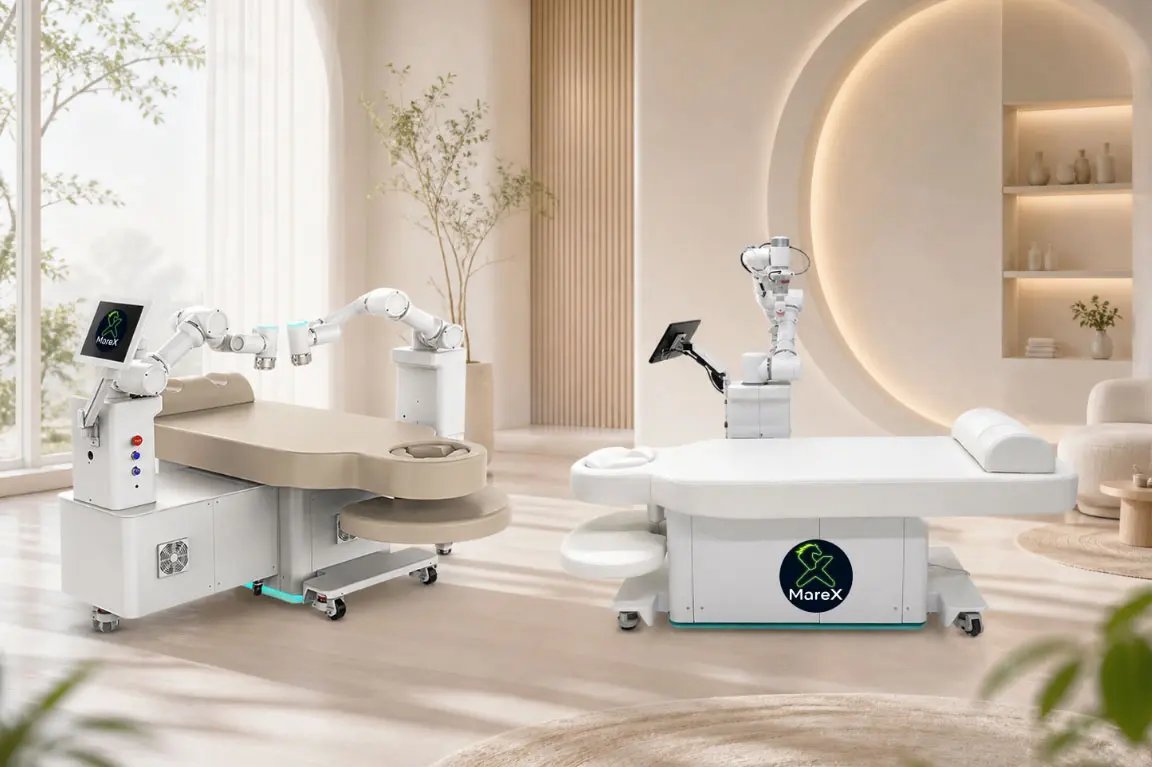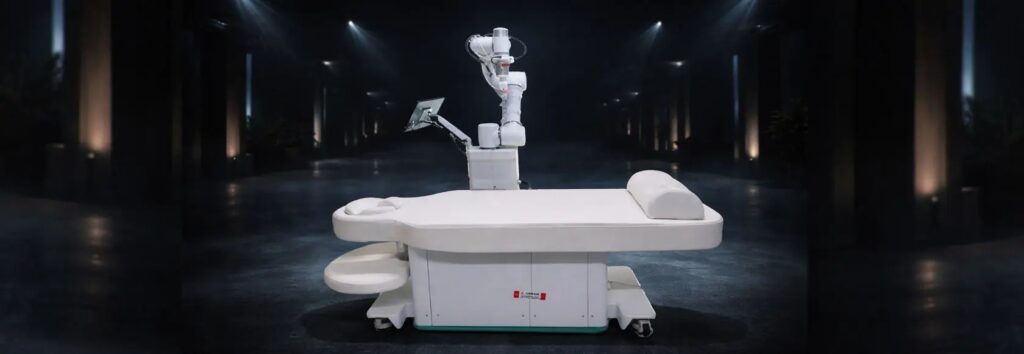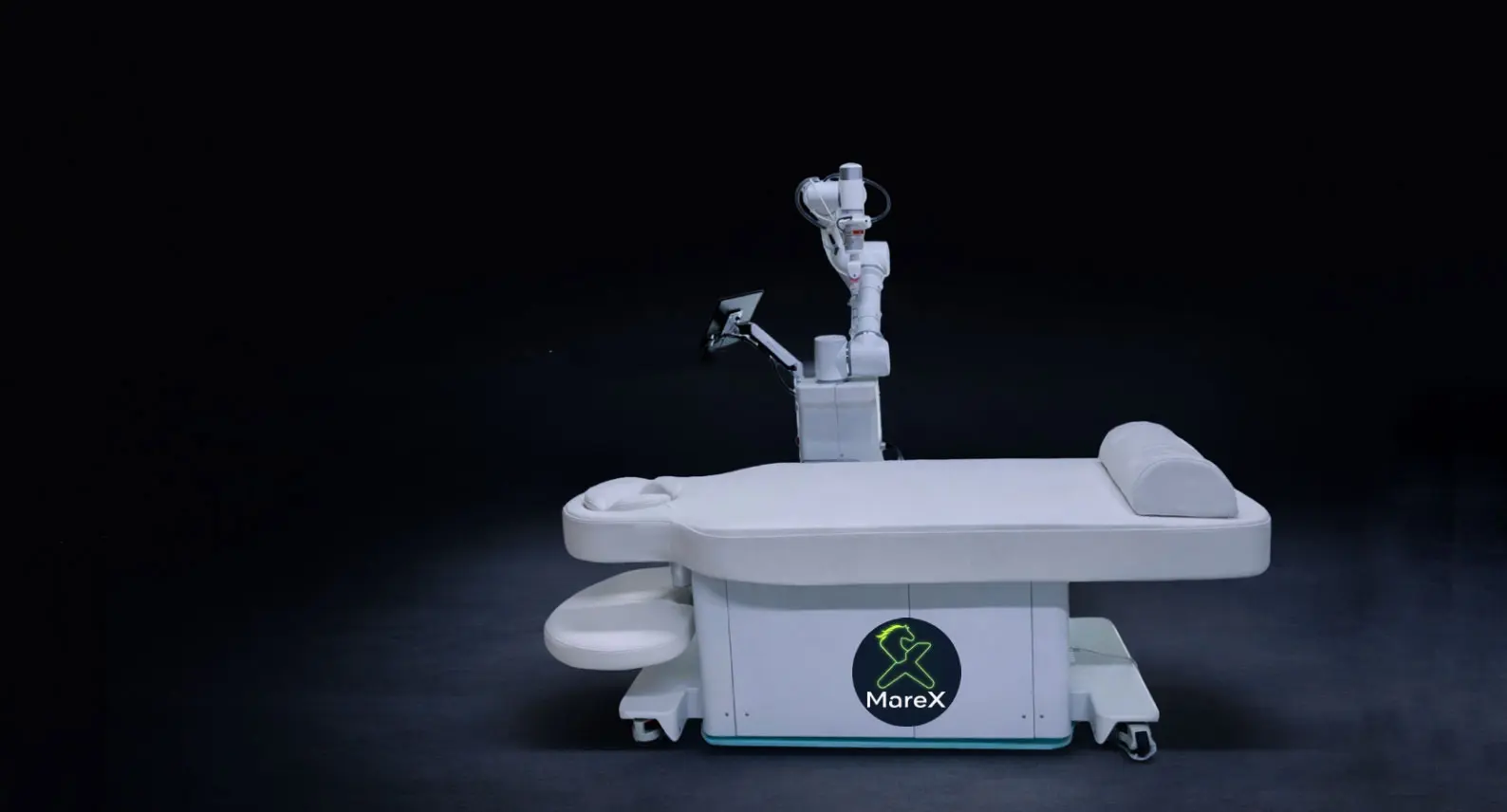
Top AI Massage Robot Manufacturers for Professional Spa Centers

The spa and wellness industry is undergoing a major technological transformation. Traditionally centered around manual therapy, personalized human interaction, and sensory relaxation environments, modern spa operations are now integrating intelligent automation to improve efficiency, consistency, and scalability.

One of the most significant innovations driving this shift is the emergence of AI massage robots. Once viewed as experimental wellness technology, these advanced robotic therapy systems are now being deployed in professional spa centers, luxury fitness facilities, and high-end wellness resorts worldwide.

Unlike conventional massage equipment, AI-powered massage robots combine robotics, sensor fusion, force-control systems, and machine learning algorithms to deliver adaptive and data-driven therapy experiences. These systems are designed to replicate human massage techniques with high precision while maintaining consistent treatment quality across multiple sessions.

What is an AI Massage Robot (and Why Everyone’s Talking About It)

An AI massage robot is basically a robotic system designed to replicate human massage techniques using sensors, machine learning, and precision-controlled movements.

But here’s where it gets interesting — these machines don’t just “copy” massage patterns. They actually adapt.

They can:

  • Analyze body tension in real time
  • Adjust pressure automatically
  • Customize massage routines based on user preference
  • Maintain consistency (something even trained therapists struggle with over long shifts)

Some advanced systems use 3D scanning and AI modeling to map the body before starting the session. 

And industry reports suggest the global wellness robotics market is growing fast, with spa automation becoming a key segment. Not hype. Actual demand.

Why Spa Centers Are Adopting AI Massage Robots

1. Consistency is a big deal

Human therapists vary. Skill levels differ. Fatigue happens.AI doesn’t get tired. A robotic massage machine manufacturer builds systems that deliver the same quality every single session.

2. Staff shortages are real

Many spa businesses struggle to hire and retain skilled therapists.AI massage robots help fill that gap without compromising service availability.

3. Scalability

A spa with 3 therapists can only serve so many clients per day.Add 2 robots? You’ve basically increased capacity without increasing HR headaches.

Real-world example

Luxury wellness centers in the US and parts of Europe are already integrating AI massage systems into premium packages.

Clients often choose robotic sessions for:

  • Deep tissue precision
  • Privacy (no human interaction)
  • Faster availability

It’s not replacing traditional massage — it’s becoming a parallel service line.

Top AI Massage Robot Manufacturers for Spa Centers

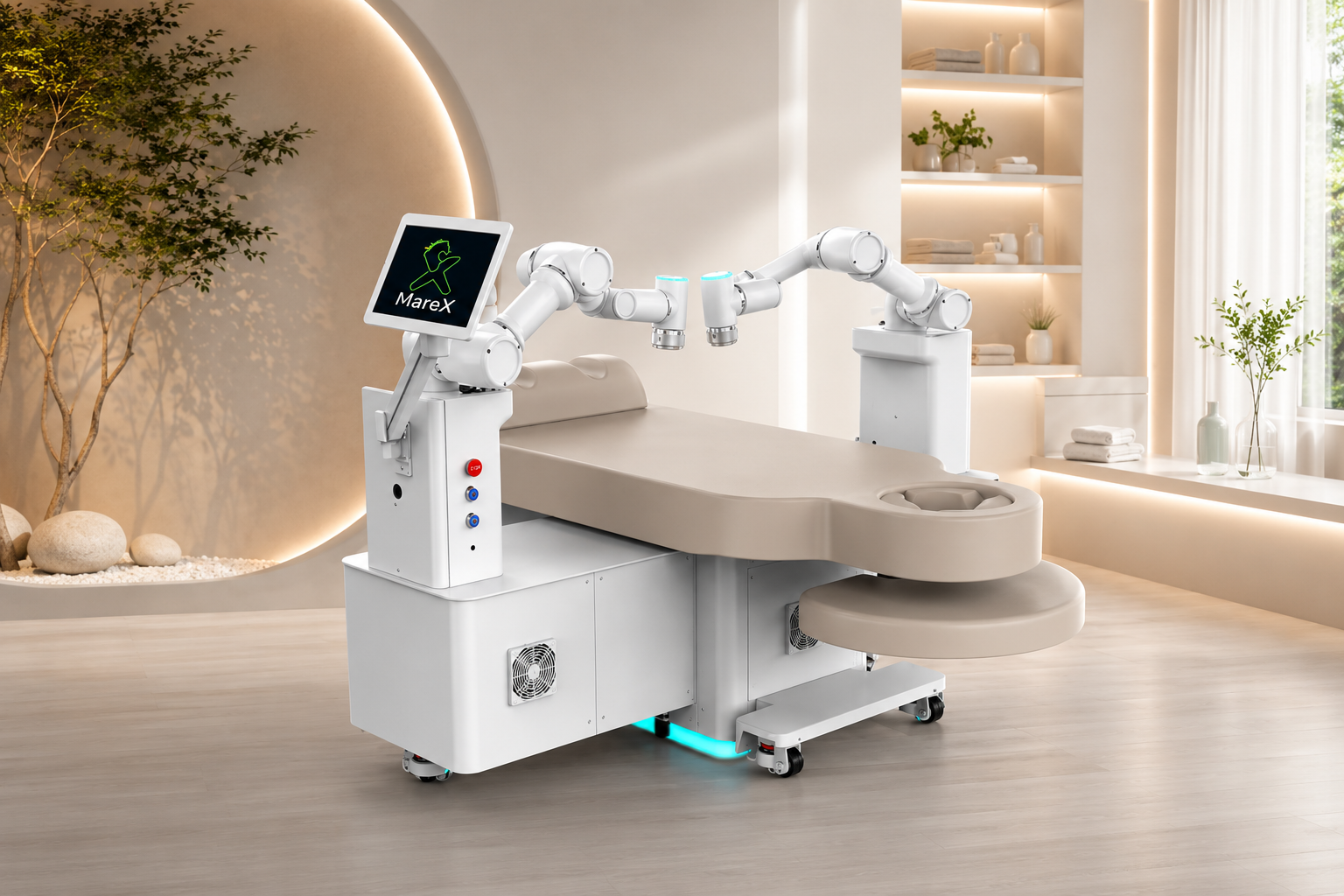
1. Mare-X — Advanced Robotics Built for Real Spa Use

Mare-X is one of those companies that’s quietly doing serious work in this space. It more focus on engineering and practical deployment.

What they offer

  • High-precision robotic massage systems
  • AI-driven pressure adjustment
  • Customizable treatment programs

Strengths

  • Built specifically for professional environments
  • Strong focus on durability and long-term use
  • Reliable performance across different body types

Why spa owners consider them

The truth is, a lot of ai massage robot manufacturers focus on prototypes. Mare-X leans more toward usable, scalable systems.Also, their approach to product quality and delivery reliability stands out. If you’re running a spa, delays and technical issues are the last thing you want.

2. Capsix Robotics — European Engineering Approach

Capsix brings a slightly different angle — more clinical precision and European engineering standards.

Key features

  • Sensor-based body mapping
  • Automated therapy customization
  • Clean, minimalist machine design

Strengths

  • Strong R&D foundation
  • Focus on therapeutic accuracy
  • Suitable for both wellness and medical recovery spaces

Why it matters

If your spa leans toward rehab, physiotherapy, or medical-grade services, this kind of robot massager manufacturer is worth looking at.

3. Aescape — The Premium AI Massage Experience

Aescape is probably one of the most talked-about names in this space right now.

What makes them different

  • AI-powered full-body scanning
  • Personalized massage sessions
  • App-based customization

Strengths

  • High-end user experience
  • Strong branding and market positioning
  • Designed for luxury spa environments

Real talk

Aescape isn’t trying to compete on price — they’re building a premium experience.

So if you run a luxury spa or wellness club, this robotic massage machine manufacturer fits that vibe perfectly.

4. AiTreat — Practical, Scalable Solutions

AiTreat focuses more on accessibility and scalability rather than just high-end features.

Features

  • Automated massage routines
  • Smart pressure control
  • Easy integration into spa workflows

Strengths

  • Cost-effective compared to premium brands
  • Faster deployment timelines
  • Suitable for mid-sized spa businesses

Why people choose them

Not every spa wants a luxury robotic setup. Some just want efficiency and reliability.AiTreat fits that space well as a massage robot manufacturer that balances cost and performance.

What to Look for in an AI Massage Robot Manufacturer

Before you choose, here’s what actually matters:

Product Quality

This is non-negotiable. Machines run daily — poor build quality will cost you more in repairs than the initial price.

Delivery & Installation

Fast, discreet delivery matters. Especially if you’re upgrading an existing spa setup.

Software & Updates

AI systems improve over time. Choose a manufacturer that supports updates and improvements.

Customer Support

Let’s be honest — things will go wrong at some point. Good support makes all the difference.

Future of AI Massage Robots in the Spa Industry

The future looks… pretty solid, honestly.

We’re moving toward:

  • Hyper-personalized massage sessions
  • Integration with health data (wearables, fitness apps)
  • Fully automated spa rooms

And no, human therapists aren’t going away.

What’s happening is a shift — spas offering both human and AI treatments. More options, better scalability, and higher customer satisfaction.

In the next 5–10 years, it won’t be surprising if every major spa chain has at least one Ai massage Robot setup.

FAQs

Are AI massage robots safe?

Yes, most systems are designed with sensors that prevent excessive pressure and adapt to body movement in real time.

Can they replace human therapists?

Not really. They complement them. Some clients still prefer human touch, others prefer precision and privacy.

How much does an AI massage robot cost?

It varies a lot. Entry-level systems are more affordable, while premium solutions can be a serious investment.

Are they suitable for small spas?

Yes, especially models from scalable manufacturers. It depends on your budget and client demand.

Do clients actually like robotic massages?

Surprisingly, yes. Many clients appreciate the consistency and customization.

Conclusion

AI massage robots aren’t just a trend — they’re becoming part of how modern spa businesses operate.

From improving service consistency to solving staffing issues, the value is clear. And manufacturers like Mare-X, Capsix, Aescape, and AiTreat are pushing this space forward in different ways.

If you’re running a spa center, it might be time to seriously consider adding this tech. Not replacing your team — just upgrading your offering.

AI Massage Robot Architecture: Sensor Fusion, Force Control, and Intelligent Therapy Automation

The evolution of robotic therapy systems has led to a new class of intelligent machines—AI-powered massage robots. These systems are not just automated tools; they are precision-controlled, sensor-driven platforms capable of delivering consistent, adaptive, and personalized therapy. In many modern applications, AI powered robot massage systems are becoming a practical solution for automation-driven therapy environments, especially where consistency and repeatability matter.At the core of this innovation lies a combination of sensor fusion, force control algorithms, and intelligent automation frameworks.For manufacturers and engineers, understanding the architecture behind these systems is essential to achieving high performance, safety, and user satisfaction

System Architecture Overview

Most AI massage robots follow a three-layer structure. Clean. Functional.

1. Perception Layer (Sensors & Data)

This is where everything starts. The robot needs to “feel” before it can act. No shortcuts here.

2. Control Layer (Processing & Decision Making)

Raw data comes in. Algorithms process it. Decisions get made—how much force, where to move, when to stop.

3. Execution Layer (Actuators & Mechanics)

Motors, joints, mechanical arms. This is where intention becomes motion.

All three layers run in a loop. Constant feedback. Adjustments happening in milliseconds. If that loop breaks, performance drops fast.

Sensor Fusion: The Foundation of Precision 

Sensor fusion combines multiple data streams into something usable. More accurate. More reliable.

Typical setup includes:

  • Force/Torque Sensors
  • Tactile (pressure) sensors
  • Position encoders
  • IMUs (orientation + motion tracking)

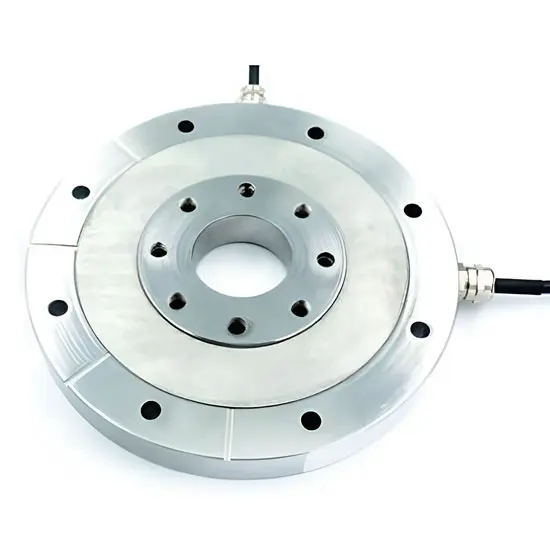
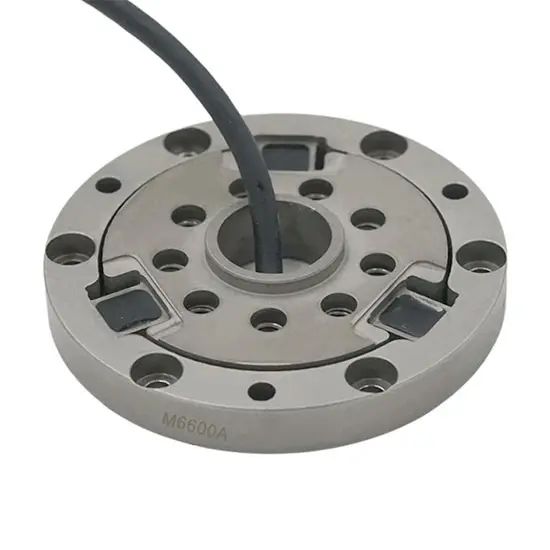
Individually, each one has limits. Together, they fill the gaps.The robot can map body contours, detect resistance, and adjust pressure in real time. That’s the difference between a rigid machine and something that feels… responsive.A multi-axis force torque sensor plays a big role here. It doesn’t just measure push—it tracks force in all directions. Subtle changes. Micro-adjustments. That’s where precision lives.

Force Control Systems

If there’s one thing that defines whether these systems work or fail—it’s force control.You’re not moving objects. .Three main strategies show up a lot:

Impedance Control

Adjusts how “stiff” or “compliant” the robot feels. More resistance? It softens.

Admittance Control

The opposite approach. External force drives motion changes.

Hybrid Control

Mixes position and force control. More balanced. Usually more practical in real systems.

None of these are perfect on their own. Engineers tweak them constantly.

The goal is simple:

  • Keep pressure consistent
  • Adapt across body regions
  • Never exceed safe limits

Intelligent Therapy Automation (Where AI Actually Helps)

AI in this space isn’t magic. It’s pattern recognition and optimization. That’s it.But used correctly—it’s powerful.

These systems can:

  • Identify tension zones based on resistance patterns
  • Adjust intensity without manual input
  • Learn user preferences over time

Not instantly. Not perfectly. But gradually, they get better.Machine learning models process historical data. Small improvements stack up. Eventually, the system starts to feel tailored.Still, AI doesn’t replace engineering fundamentals. If your sensor data is bad, AI won’t fix it. It just amplifies the problem.

Mechanical Design and Actuation

This part gets overlooked sometimes. It should not .You can have the best algorithms in the world—if the hardware isn’t smooth, it shows.

Execution layer includes:

  • Multi-axis robotic arms
  • Precision motors
  • Soft-contact end effectors

The goal is to replicate human motion. Not exactly, but close enough.

Kneading. Pressing. Tapping. These aren’t just movements—they’re force patterns over time.

And consistency matters more than complexity. A simple motion done well beats a complex one done poorly.

Role of High-Precision Force Torque Sensors

This is where quality really shows.Cheap sensors? You’ll see drift, noise, inconsistency. Over time, performance degrades. Users notice.

High-quality sensors give:

  • Stable real-time feedback
  • Multi-axis force measurement (Fx, Fy, Fz, Tx, Ty, Tz)
  • Better repeatability
  • Safer interaction

That last point matters more than most people admit.Manufacturers like MareX Technology Co., Ltd focus heavily on this space—custom multi-axis sensors designed specifically for robotics. Not generic parts. Application-specific design.

Conclusion

AI massage robots sit at an intersection—robotics, sensing, control systems, and AI. You can’t ignore any one of these.

The strength of AI Massage Robot Architecture comes down to balance:

  • Accurate sensor fusion
  • Reliable force control
  • Thoughtful automation

Cut corners in any of those, and the system feels it.For engineers and manufacturers, the real focus shouldn’t be just innovation. It should be quality and long-term performance. Because in this kind of application, consistency matters more than novelty.And honestly, that’s what separates systems that work… from ones that just look good on paper.

    Your Attractive Heading

    Custom vs Standard Force Torque Sensors: Which One Do You Need?

    If you’re here, you are probably trying to decide between a custom force torque sensor and a standard one. , they look similar. Both measure force. Both measure torque. Both claim “high precision.”

    Some people buy a standard sensor and it works fine. Others try the same thing and end up wasting time, money, and patience. Happens a lot more than vendors admit.

    What Is a Force Torque Sensor?

    Before we jump into custom vs standard, just a quick reset. A force torque sensor measures:

    • Force (push/pull)
    • Torque (rotational force)

    But when you start dealing with robotics, automation, testing system things get messy. You’re not just measuring one direction. You’re dealing with multi-axis loads, vibrations, temperature changes, weird mounting setups.

    Standard Force Torque Sensors: The Easy Option

    A standard force torque sensor is basically an off-the-shelf product. Pre-designed. Pre-tested. Ready to ship.

    Why people choose standard sensors

    • Faster delivery
    • Lower cost (usually)
    • Proven design
    • Easy integration (in common setups)

    For example:

    • Basic robotic arms
    • Lab testing setups
    • Simple industrial automation

    Common issues with standard sensors

    • Doesn’t fit your mounting setup properly
    • Limited measurement range
    • Not sensitive enough (or too sensitive)
    • Struggles in harsh environments
    • Integration becomes “adjust everything else to fit the sensor”

    Custom Force Torque Sensors: Built for Your Problem

    Now let’s talk about custom force torque sensors.These aren’t off-the-shelf. They’re designed around your application.Your load. Your environment. Your system.Yeah, it takes more time upfront. But sometimes that’s exactly what you need.

    Why Go Custom? (Real Reasons, Not Marketing Talk)

    1. Perfect Fit (Literally)

    Custom sensors are designed to match:

    • Your mounting interface
    • Your mechanical structure
    • Your system layout

    No hacks. No adapters. No “let’s just make it work.”

    2. Right Measurement Range

    Standard sensors come in fixed ranges.

    But what if:

    • Your force is too low? → You lose accuracy
    • Your force is too high? → You risk damage

    Custom sensors solve this by matching the exact range you need.

    3. Better Accuracy Where It Matters

    Let’s be real.

    Accuracy isn’t just about numbers on a datasheet.

    It’s about:

    • Your specific load conditions
    • Direction of forces
    • Real working environment

    Custom sensors are tuned for that. Standard ones… not really.

    4. Works in Harsh Conditions

    If you’re dealing with:

    • High temperature
    • Dust
    • Moisture
    • Vibrations

    Standard sensors can struggle.

    Custom ones? Designed for it from day one.

    5. Integration Becomes Easier (Yes, Easier)

    Sounds backward, but it’s true.

    Instead of forcing your system to adapt to the sensor…

    The sensor adapts to your system.

    Big difference.

    So… Which One Should You Choose?

    Alright, let’s cut through the noise.

    Choose a Standard Force Torque Sensor if:

    • Your application is simple
    • Budget is tight
    • You need something fast
    • Your requirements match available models

    Basically… if nothing is “special” about your setup.

    Choose a Custom Force Torque Sensor if:

    • Your application is complex
    • You need high precision
    • Your setup is unique
    • Standard options don’t fit properly
    • You care about long-term performance

    And honestly… most industrial applications fall into this category.

    Cost: The Thing Everyone Worries About

    Standard sensors:

    • Lower upfront cost
    • Quick purchase
    • Minimal customization cost

    You might spend more later fixing integration issues.

    Custom sensors:

    • Higher initial cost
    • Longer development time

    But…

    • Better performance
    • Less modification needed
    • Lower long-term cost (in many cases)

    Truth is, cheap upfront doesn’t always mean cheap overall.

    Real-World Example (This Happens a Lot)

    A company building a robotic system needed a multi axis force torque sensor.They went with a standard model.Looked good on paper.

    But then:

    • Mounting didn’t align properly
    • Readings were slightly off under real load
    • Calibration became a headache

    They ended up redesigning parts of the system just to fit the sensor.Later switched to a custom solution.Everything aligned. Data stabilized. Problem solved.Could’ve saved months if they started there.

    Performance vs Convenience (The Real Trade-Off)

    This is what it comes down to.

    FactorStandard SensorCustom Sensor
    SpeedFastSlower
    CostLower upfrontHigher upfront
    FitGeneralPerfect
    AccuracyGoodOptimized
    FlexibilityLimitedHigh

    No option is “better” universally.

    It depends on what you’re building.

    When Standard Sensors Actually Make More Sense

    Let’s not ignore this.

    Custom isn’t always the answer.

    Standard sensors are perfect when:

    • You’re prototyping
    • Testing an idea
    • Running non-critical measurements
    • Working on budget constraints

    Sometimes “good enough” really is enough.

    When Custom Is the Only Logical Choice

    On the other side…

    If your system:

    • Requires consistent accuracy
    • Handles complex loads
    • Needs long-term reliability

    Then forcing a standard sensor into that setup is… not smart.

    You’ll feel it later.

    Multi Axis Force Torque Sensors (Quick Note)

    Most modern applications don’t deal with just one direction.

    They use multi axis force torque sensors.

    These measure:

    • X, Y, Z force
    • Torque in multiple directions

    And this is exactly where custom solutions shine.Because real-world forces are messy. Not clean. Not predictable.

    FAQs

    What is the difference between custom and standard force torque sensors?

    Standard sensors are pre-built and ready to use, while custom force torque sensors are designed specifically for your application, offering better fit and performance.

    Are custom force torque sensors more accurate?

    Yes, in most cases. Custom sensors are optimized for specific conditions, which improves accuracy compared to general-purpose standard sensors.

    When should I use a standard force torque sensor?

    Use a standard sensor when your application is simple, budget is limited, and your requirements match available models.

    Are custom sensors worth the cost?

    If your application is complex or requires high precision, then yes. They often save time and cost in the long run.

    What industries use force torque sensors?

    Force torque sensors are widely used in:

    • Robotics
    • Industrial automation
    • Aerospace
    • Automotive testing
    • Medical devices

    What is a multi axis force torque sensor?

    A multi axis force torque sensor measures force and torque in multiple directions (X, Y, Z), making it ideal for complex and dynamic applications

    Let’s be real—robots are only as good as what they can feel. Sounds odd, but it’s true. In 2026, accuracy isn’t just about better code or faster processors. It’s about sensing. And this is where force torque sensors quietly do the heavy lifting. Most people overlook them. Big mistake. These sensors are the reason a robot arm doesn’t crush a fragile component or miss a precise movement by a millimeter. They give robots something close to “touch,” not human-level, obviously, but enough to make a serious difference. The short answer is simple: better sensing equals better accuracy. But the real story goes deeper than that.

    What Are Force Torque Sensors ?

     Force torque sensors measure forces and rotational movements acting on an object. That’s it. But don’t let that simple definition fool you. These sensors detect tiny changes—pressure, twist, load—that humans can barely notice. In robotics, they sit between the robot arm and the tool, constantly feeding data back to the system.

    So instead of a robot just following instructions blindly, it adjusts in real time. If something pushes back, it knows. If resistance changes, it reacts. Without this, robots are basically guessing. And guessing is not what you want in manufacturing or automation.

    Why Robot Accuracy Still Matters (Even More in 2026)

    You’d think robots are already precise enough. Not quite. Industries are pushing limits every year. Electronics are smaller. Medical devices are more delicate. Automation lines run faster than ever. There’s less room for error now.

    Accuracy isn’t just about hitting the right spot. It’s about consistency. Over and over again. No drift. No slight misalignment. Because even a tiny error, repeated thousands of times, becomes a big problem. That’s where quality comes in. High-quality sensing systems don’t just improve performance today—they keep it stable long-term. And that long-term value? It saves money, reduces downtime, and honestly, keeps businesses sane.

    How Force Torque Sensors Actually Improve Accuracy

    1. Real-Time Feedback (this is the big one)

    Robots without feedback are basically following a script. Add force torque sensors, and suddenly they can “feel” what’s happening. If a part is slightly off, the robot adjusts instantly. No delay. No reprogramming.

    This is huge in assembly lines. Instead of stopping everything for minor issues, the robot adapts on the fly. That’s accuracy in motion.

    2. Better Control During Contact Tasks

    Think about tasks like polishing, welding, or inserting components. These require contact. And contact means variables.

    Force torque sensors help control how much force is applied. Not too much, not too little. Just right. Without them, robots either press too hard or too soft. Both are bad. With them, you get consistent pressure every time. That’s where precision really shows up.

    3. Reducing Errors and Waste

    Let’s be honest—errors cost money. Scrap materials, rework, downtime… it adds up fast.

    When robots use high-quality sensors, mistakes drop. Not completely, but significantly. The system catches issues early. Adjusts before things go wrong. That means fewer defective products and smoother operations.

    4. Improving Calibration Over Time

    Here’s something people don’t talk about enough. Sensors help robots stay accurate over time.

    Machines wear down. Parts shift slightly. Calibration drifts. It happens. But with continuous force feedback, robots can compensate. They stay aligned longer without constant manual recalibration. That’s long-term value right there.

    5. Supporting Advanced AI and Automation

    In 2026, AI-driven robotics is everywhere. But AI needs data. Good data.

    Force torque sensors provide that data. Clean, precise, real-time input. This allows AI systems to learn and improve. Without sensors, AI is basically guessing patterns. With sensors, it actually understands physical interaction. Big difference.

    Why Quality of Sensors Matters ?

    Not all sensors are equal. Some are cheap. Some are costly let’s just say unreliable.

    High-quality force torque sensors offer better sensitivity, durability, and accuracy. They don’t drift as much. They last longer. And they perform consistently under pressure—literally.

    Cutting corners here is a bad move. You might save money upfront, sure. But long-term? You’ll pay for it in errors, maintenance, and downtime. Investing in quality sensors is one of those decisions that just makes sense over time.

    Real-World Use Cases (Where This Actually Shows Up)

    You’ll see force torque sensors in industries like:

    • Robotics assembly lines
    • Medical robotics (super precise work)
    • Automotive manufacturing
    • Electronics production
    • Packaging automation

    The Long-Term Value You Can’t Ignore

    Here’s the truth. Force torque sensors aren’t just about improving accuracy today. They’re about sustaining it.

    They reduce wear and tear. Improve consistency. Lower error rates. And help systems adapt over time. That’s not a small thing.

    In a world where automation is only getting more complex, having reliable sensing isn’t optional anymore. It’s foundational.

    FAQs

    What is a force torque sensor in robotics?

    A force torque sensor measures force and rotational movement, helping robots understand how much pressure or resistance they are applying during tasks.

    How do force torque sensors improve robot accuracy?

    They provide real-time feedback, allowing robots to adjust movements instantly and maintain precise control during operations.

    Are force torque sensors necessary for all robots?

    Not all, but for tasks involving precision, contact, or delicate handling—they’re essential.

    Do high-quality sensors make a big difference?

    Yes, absolutely. Better sensors offer higher accuracy, longer lifespan, and more reliable performance over time.

    What industries benefit the most from these sensors?

    Industries like manufacturing, medical robotics, automotive, and electronics see the biggest gains in accuracy and efficiency.

    How Force and Torque Sensors Improve Industrial Automation Efficiency

    Introduction

    In the advanced sensing technology industry, MareX custom sensors emphasize the growing need for automation in mass industrial scaling and maintaining optimal automation systems. Automation requires mass industrial scaling for distribution, but it also demands manufacturers leverage competitors in automation, accuracy, and productivity. Within MareX sensors, the automation industry is demanding the capabilities offered by MareX of forcing and torque sensors, heightening productivity and accuracy across automation systems.

    Understanding Force and Torque Sensors in Automation

    The automation systems utilize force and torque sensors in the robotics systems of industrial automation. Total task performance and system implementation are reliant upon a robotics systems adaptability and safety. Industrial automation demands the force and torque sensors in quality control, testing, material handling, and assembly.

    Automation system manufacturers incorporating multi axis force torque sensors will capture force data across multiple axes and across a number of dimensions. A direct example is the 6 axis configurations capturing force and torque data across the X, Y, and Z axes and allowing for more ample configurations. The innovation demands radical flexibility and accuracy across the robotics of automation.

    Enhancing Precision and Operational Efficiency

    Force and torque sensors enable innovation across industry, automation systems, and mass production. Precise control of robotic automation systems drives innovation in task performance.
    Tasks like carving and assembling are autonomous, without operators, but innovation has afforded automation systems the same flexibility and adaptability across multiple tasks including the bolts in construction and the various delicate components and surfaces.

    Machines equipped with torque sensors are able to perform at the same or even better level of the competitor as the human worker in any task, along with improved efficiency with eliminated unnecessary steps in a process.

    For an industry looking to buy custom sensors online, accurate selection assures a desired outcome that produces a consistent level of output with reduced error and a maximized throughput of productive cycles overall.

    Role of Multi-Axis Sensors in Advanced Automation

    Increasingly, multi axis force sensor online are used in most advanced automation systems as opposed to single axis sensors because multi axis sensors are more complete in providing an omni-directional visualization of the force that is acting on a component, and most importantly, unlike single sensors, are able to provide the multi axis systems the required

    High-level automation functions require multi-axis sensors and specialized multi-axis sensor systems to perform most of the dynamic functions involved in a task.

    For example, multi-axis sensors in robotic assembly detect misaligned parts and adjust movements accordingly, and they maintain and control applied force in grinding, welding, polishing, and similar processes to ensure a consistent level and prevent damage.

    As a joint torque sensor manufacturer, MareX constructs and manufactures sensors that integrate directly into robotic joint assemblies, and these sensors enable engineers to optimize how systems apply torque while they achieve more advanced and better-integrated control over motion and design during assembly. This becomes especially important in collaborative robots (cobots), where engineers design systems to deliver highly responsive, finely tuned control that closely matches the desired end-level performance and overall control outcomes.

    Improving Safety in Industrial Environments

    Force and torque sensors primarily enhance safety in automation environments where humans interact with robotic systems, especially when robotic structures operate against applied forces within integrated, controlled, and responsive assemblies.

    By developing more advanced systems that have a limited design for the level of control as to the desired end control, as well as for the overall design and the structure of the robotic structure as far as the force and control of the design to control the overall system structure of the robotic system as far as the force implemented to control the overall safety of the system, control, and functional level, the systems can improve their overall structural integrity and overall functioning level close to the desired end control or functioning level of the robotic system close to the desired end goal of the desired end control or functional level of the integrated and improved overall level of control to provide integrated and improved systems.

    Boosting Quality Control and Consistency

    Quality assurance becomes a straightforward task with force and torque sensors, as consistency is an aspect of manufacturing that is crucial. These sensors allow automated systems to carry out commands with utmost precision, and as such work wonderfully in manufacturing and inspection quality.

    As a case in point, sensors are able to gauge the force needed to perform a button press or how durable a component is over a number of repeated cycles. This is done to ensure that a product is born to meet all the necessary quality requirements before being sold on the market.

    A notable torque sensor manufacturer such as MareX are able to give businesses the means to create, and in turn, maintain quality consistency as well as lessen the load of manual inspection.

    Custom Sensor Manufacturing for Specialized Applications

    There are many different needs in a multitude of different industries, and that is why a more universal technology is applied. In such a case, custom sensor manufacturing is an absolute necessity.

    MareX is experienced in manufacturing sensors that deal with particular needs such as extreme temperatures, high levels of vibrations, as well as high complexity. This is why custom sensors are leaps and bounds better in terms of functionality and performance as compared to out of box sensors.

    Forms of businesses that are looking to buy custom sensors online, are customs designs that correlate seamlessly with their automation systems and provide ease of access, functionality, and, most importantly, a cost-effective solution.

    Enabling Smart Manufacturing and Industry 4.0

    The evolution of Industry 4.0 places more importance on interconnected and intelligent systems. Force and torque sensors provide real-time information that can be analyzed for advanced decision making.

    Sensors provide early detection so failures can be avoided and optimized processes are better understood.

    Increased productivity and profitability in automated environments are a result of the use of force and torque sensing in robotic processes, such as grinding, polishing and assembly.

    MareX is a custom industrial sensor supplier that partners with industries leveraging innovative sensor technologies to usher in a new level of smart manufacturing practices.

    Applications Across Industries

    Force and torque sensors are applicable in a multitude of industries:

    • Robotics: Increasing accuracy of robotic arms and collaborative robots
    • Automotive: Ensuring correct torque distribution in assembly lines
    • Aerospace: Assisting with precision testing and operations that are safety-critical
    • Manufacturing: Enhancing the effectiveness of quality control
    • Research & Development: Facilitating precise testing

    Selecting a torque sensor manufacturer allows for competent solutions in industrial processes that are modern and evolving.

    Why Choose MareX Technology Co., Ltd

    MareX Technology Co., Ltd is a recognized leader in advanced sensing solutions, specializing in custom sensor development. Multi axis force torque sensor systems and high performance sensors are among their extensive product offerings.

    MareX specializes in innovative and precise design, ensuring high-quality products tailored to the client’s needs. Expect nothing less than the most durable and efficient products when selecting a custom sensor online.

    Conclusion

    Force and torque sensors are revolutionizing industrial automation by increasing the precision, safety, and efficiency of automation. These sensors are enabling machines to work smarter and more effectively from multi axis force sensor online solutions to other advanced custom solutions.

    As the industrial world continues to develop, so does the need for reliable high performance sensors sensing solutions. Working with a reputable custom industrial sensor supplier such as MareX Technology Co., Ltd, ensures the most advanced solutions for maximizing industrial automation with productivity and creativity.

    Selecting the appropriate sensor solutions provides the foundation for a more intelligent, safe, and efficient automation system of the future.

    Visit Us at WHX Miami 2026

    We will be attending the medical exhibition (WHX Miami) in Miami this June, welcome to come and know more about it then. 

    AI Massage Robot Manufacturer | OEM & ODM Expertise

    We don’t just sell robots; we build your brand. 🦾
    ✅10+ years of OEM/ODM experience in AI wellness tech.
    ✔️Customize design, software, and packaging.
    ✔️ High-quality, certified, and ready for global markets.

    Please contact [email protected] for wholesale inquiries & partnership.

    Robotics has progressed beyond simple repetitive processes to systems that can think, adjust, and make decisions on the fly. One of the key elements to this evolution is superior sensing technology, and, more specifically, the multi axis force torque sensor. These sensors allow robots to engage and manipulate their environments. As high-performance sensing systems are introduced to industrial automation and collaborative robotics, the overall capability of machines is transformed.

    In this piece, we highlight the key advantages that multi-axis force sensors provide to the fields of robotics and the contributions made to overall performance, operational efficiency, and reliability.

    multi axis force torque sensor

    Multi-Axis Force Sensors in Robotics explained

    A multi axis force torque sensor detects multiple axial forces (Fx, Fy, Fz) and multiple axial torques (Mx, My, Mz), and does so at the same time. It can do this in contrast to older sensors that only capture one dimension. These sensors enable the user to better understand how forces work and are utilized in the real world.

    This is extremely valuable in the robotics field, where linear movements are the exception. Robots require sophisticated and precise multi-directional feedback in order to complete any of their tasks—gripping, lifting, assembling, polishing, and many more.

    1. Greater Precision and Control

    Robotics is especially susceptible to the positive impacts that multi-axis sensors provide, and the ability to improve operational precision is the most paramount. Robotic movements can be adjusted in real time to address situational demands.

    One specific example is the integration of robot joint torque sensors into robot arms. These sensors monitor and regulate the amount of torque that is applied to each joint. As a result, the movement is made smoother, and the overall system performance is elevated. In instances where the robotics application is medical robotics or electronics assembly, the absence of precision can result in the occurrence of a defect—illustrating the necessity of precision sensing.

    2. Enhancing Force Feedback for Smart Options

    Modern sensors for robotic control systems allow robots to “feel” environmental changes. Using a multi-axis force torque sensor helps robots make smart decisions by measuring and reporting a combination of forces and torques.

    Force sensors are particularly good for:

    • Robotic gripping and handling
    • Surface finishing and polishing
    • Human-robot collaboration

    With precise engineering, robots can detect slip, respond to counter force, and alter grip strength like a human.

    3. Robotic Operations Safety

    Safety in a robotic working environment, especially one that combines human and robotic interaction, is a primary concern. Police multi-axis force sensors to detect contact or forces that exceed prescribed parameters and trigger a response.

    In robotic application, the sensors:

    • Trigger a stop in the event of an unforeseen impact
    • Minimize the chance of damaging the facilities
    • Create a safe working environment in collaborative robotics (cobots)

    By measuring and controlling forces in the environment, the robots act quickly to keep the working environment safe and mechanized.

    4. Wide Range of Applications

    One of the greatest advantages of multi-axis sensors is the ability to be used in a variety of applications. One multi axis force torque sensor can be used for numerous applications, eliminating the need for numerous sensing devices.

    The following industries have a need for such sensors:

    • Automotive
    • Aerospace
    • Electronics
    • Materials (testing and quality control)

    The ability to measure force in several directions and rotate freely in an unbiased manner is ideal for applications that are versatile and require a very high degree of precision and flexibility.

    5. Optimized Performance in Robotic End-Effectors

    Good functioning end-effectors like grippers or tools require precise force data, which multi-axis sensors feedback to improve end-effectors usage.

    For example, when robots perform tasks such as assembling, to avoid errors and improve quality of the product with less wastage the sensor enables the robot to use just the exact amount of force.

    6. Tailored Solutions to Meet Individual Needs of Applications

    With the unique nature of every robotic process, the necessity of custom sensor manufacturing comes in as standard sensors cannot cater to the specific demands of intricate mechanisms.

    MareX excels in the development and design of custom sensors in accordance with the specific needs of the customer. Whether it concerns load capacity, dimensions, or type of output, bespoke solutions promote energy and performance.

    The aforementioned, means businesses can be able to:

    • Reduce operational cost
    • Enhance precision in the performance of intricate operations

    7. Instant Data Access for Refined Automation

    For smart automation in this Industrial 4.0, instantaneous or real time data availability and multi-axis force torque sensor is essential as they capture data in a formative manner to improve the system.

    The data can be put into use through:

    • Predictive maintenance
    • Optimization of process
    • Quality aspects

    Therefore, businesses with real-time data can enhance productivity and reduce the time in the systems that are automated.

    8. Less Damage to The Machinery

    The increase of maintenance of the machinery and damage can be as a result of the impact of excess force or the misuse of the torques. By keeping the forces effective and safe within the limits, multi-axis sensors minimize such effects.

    A robot joint torque sensor in a robot, for example, helps determine and maintain an optimal torque level for a robotic joint. In doing so, the sensor helps decrease the amount of mechanical stress on the entire system, and as a result, also increases the overall lifetime of the robotic system. Improving reliability also lowers the overall operational costs in the long run.

    9. Seamless Integration with Modern Robotic Systems

    New robotics need new means in which they can create sensors that can provide a better way of working with many other new technologies. Multi-axis force sensors can provide the technologies that can be compatible with the other controllers.

    New technologies that create new working controllers with new designs that allow new technologies can be used in the following:

    • Robotic arms
    • Automated production lines
    • Testing equipment

    Upgrading a system can be done in a way that the business can not have to replace the system as a result of the flexibility.

    Why Choose MareX for Multi-axis Force Sensors?

    MareX is a trusted provider and has relied on other technologies to provide composite sensors that have become a standard in robotics and automation, and provide a sensor system for robotics and automation that is multi-axis force torque sensor system. With their sensors being one of the most advanced technologies, MareX has sensors that are:

    • Highly accurate and reliable
    • Customizable in order to add to many new technologies
    • Constructed of many of the same revolutionized raw materials that allow great sensor construction

    Whether a robot joint torque sensor or other advanced sensors for robotic control systems is needed, MareX provides the robotics industry’s best.

    Conclusion

    Today, the use of multi-axis force sensors in robotics is the key to safety, efficiency, and reliability in the automation industry. They are critical for modern automation and now provide the control and decision-making process of intelligent automation.

    The added benefit of custom sensor manufacturing allows companies to develop solutions that best meet their needs and guarantee maximum application performance. The evolution of robotics will increase the need for sophisticated sensing solutions such as the multi-axis force torque sensor.

    Automation and robotics are highly competitive fields. MareX’s reliable solutions will allow businesses to maintain a competitive edge and access higher levels of innovation and efficiency.

    To ensure commensurate precision and safety within a tremendous variety of use cases, modern industries require high-performance sensors. Force and torque sensors are crucial components in robotics, automation, aerospace, automotive testing, and sophisticated manufacturing systems. For precision and reliable measurement applications, companies look for force and torque sensor providers, such as MareX, who have knowledge and experience of their specific applications.

    What do Torque and Force Sensors Mean?

    A force and torque sensor is a device that measures the degree of exerted force (push or pull) and torque (rotational force). When these sensors experience mechanical force, they transform the mechanical force into alterable electrical impulses that can be evaluated for the purposes of supervising, regulating, or empirically examining something.

    Force magnitude is usually quantized in newtons (N) as torque is in newton meters (Nm). Such precision is always required in robotic arms, production lines, and testing environments.

    Custom sensor manufacturing advancements have made it possible to build modern sensors for your specific use case requirements: size; load capacity; environmental sealing (IP66); and type of output signal.

    How Does a Force and Torque Sensor Work?

    The determining working element of a force and torque sensor is, in most cases, a strain gauge. Here’s a simplified breakdown:

    1. Mechanics of Force Application

    When there is force or torque applied to the sensor there is a transient structure change of the sensor which is called slight deformation. However, this deformation is tiny yet it is measurable.

    1. Response of Strain Gauges

    The sensor’s strain gauges respond to this deformation. When a structure experiences deformation, the strain gauges respond by altering their electrical resistance.

    1. Conversion of Signals

    The change in resistance is converted to an electrical signal. The produced signal is directly proportional to the force/torque applied.

    1. Processing of Data

    The signal is processed and calibrated to yield precise measurements, and this information can be used by real-time monitoring, feedback, and control systems.

    The sensors offer high performance, and they offer the most information when it comes to accurate measurements, which makes them essential for accurate and reliable measurement in an industry.

    What is a Multi Axis Force Torque Sensor?

    A Multi Axis Force Torque Sensor is one of the most advanced sensors in the world which measures force and torque in multiple dimensions simultaneously, as opposed to single-axis sensors which only capture measurement along one line and at one rotation point. These measures along the X, Y, and Z and also consider rotational torque about these axes.

    These sensors are widely used in robotics, especially in robotic arms and end-effectors that require intricate movements and interactions. Today, multi-axis force sensors are commercially available and are equipped with sophisticated engineering solutions for end-users in these domains.

    Primary Benefits

    • The ability to capture several different types of force simultaneously is a major benefit of this sensor.
    • Enhances accuracy on multilayered procedures.
    • Reduces the quantity of required sensors.

    Applications of Force and Torque Sensors

    Due to the versatility and accuracy, force and torque sensors have a broad range of uses in different industries.

    1. Robotics and Automation

    Force feedback from sensors like yours allows robots to do delicate and precise work. Important for things like assembly, material handling and collaborative robotics.

    1. Automotive Industry

    Databases used in engine testing, validate steering systems and components for safety and performance.

    1. Aerospace

    Helps in the structural testing and simulation to see if the components can withstand excessive forces and extreme conditions.

    1. Manufacturing and Quality Control

    During the production processes, sensors keep forces under control to ensure the quality of the final product.

    1. Medical and Biomechanics

    Measuring human interaction forces accurately have applications in prosthetics, surgical instruments, and in research.

    Importance of High Performance Sensors

    With the pace of growing innovation in industries, the demand for high performance sensors is inevitable. Sensors have a direct impact in terms of:

    • High accuracy and repeatability
    • Durability in harsh environments
    • Real-time data monitoring
    • System efficiency
    • Decreased downtimes and reduced errors.

    The torque sensors manufacturer you are dealing with should have quality assurance sensors, advanced calibration, and long-term reliability.

    Importance of Custom Sensor Manufacturing

    Not all applications can be satisfied with standard sensors. Custom sensor manufacturing comes into play in those scenarios. Custom sensors can be designed to meet demands such as:

    • Special shapes and sizes
    • Certain ranges of loads
    • Resistance to specific environmental elements (temperature, moisture, vibration)
    • Specific output signals and integration

    At MareX, we engineer bespoke solutions that cater to your operational requirements and deliver in the most difficult conditions.

    Choosing the Right Force and Torque Sensor Provider

    Selecting a force and torque sensor manufacturer demands certain considerations to facilitate selection of a manufacturer that guarantees reliability and accuracy. Here are a few factors that will influence the choice of a manufacturer:

    • Possibility of Customization: for manufacture of application specific sensors
    • Precision & Calibration: manufacturer offers high accuracy and adequate calibration support
    • Relevant Experience: Practical exposure across several industries
    • Integration: the process to be integrated with existing systems
    • Durability & Quality: The sensors are meant to withstand challenging situations

    MareX stands out as a trusted partner, offering innovative solutions backed by engineering expertise and a commitment to quality.

    The Multi Axis Sensors: The Future of Sensors

    Automation has a growing demand for precise and dynamic measurements. The multi-axis torque and force sensors are critical for the next in demand systems.

    These sensors enable machines to possess the ability to “feel” and respond to the environment around them. This ability is particularly important for the following:

    • Collaborative robots (cobots)
    • AI-driven automation
    • Advanced testing systems
    • Smart manufacturing

    The widespread availability of Multi axis force sensors for online purchase has made it easier for businesses to incorporate these sensors into their operations.

    Conclusion

    In today’s engineering world, the force and torque sensors are the backbone of industrial processes. They measure physical forces and convert them into actionable data, which can improve control, increase efficiency, and enhance safety of processes and applications.

    Sensors are key parts of almost any system, and their choice can significantly change the system quality and efficiency. You can opt for standard or custom-designed sensors. As a leading manufacturer of torque sensors and multi-axis force torque sensors, MareX provides high-end, efficient solutions to meet your needs.

    With rapid changes across various sectors, investing in sensor technologies will be a key enabler of competitiveness and preparedness for the future.

    Custom Sensor Manufacturing Expert

    The rapid pace of change makes accurate data essential for modern business. And central to the collection of that data are sensors. They measure temperature, pressure, motion and flow among other critical values. These measurements allow machines to run without a hitch and safely. Standard sensors could be purchased for any general scenario, however are not always suitable for each situation. That is where Custom Sensor Manufacturing comes into play.

    We believe that no business should have convoluted their systems to conform to dumb sensors; at MareX, we design with adaptability in mind. The sensor is better off designed according to the system’s specific requirements. By partnering with an expert in custom sensor manufacturing, these companies have the opportunity to improve performance, mitigate risk, and create better products.

    Understanding the Real Need

    Every industry has different challenges. A marine business is handling saltwater and humidity. An industrial plant is exposed to heat, pressure and vibration. Medical equipment as a whole needs exceptional precision and very stringent safety standards. Standardized sensors have more general purpose designs and therefore do not necessarily operate optimally in all environments.

    Custom Sensor Manufacturing addresses this issue by designing sensors to meet the specific needs of the job. All of these factors are selected for the sensor based on where it is going to be used and how. Trade-offs are thus rendered moot. A better fit between sensor and application leads to more effective, longer-lasting systems.

    Improved Accuracy and Performance

    One key reason that companies adopt Custom Sensor Manufacturing is accuracy. Measurement errors amounting to even a few millimeters can lead to system failures, or reduced efficiencies over time. Each sensor is bespoke calibrated for its use. This enhances measurement precision and consistency.

    Machines run better when sensors tell the truth. Maintenance can be planned properly. Unexpected breakdowns become less common. In the long run accurate sensing increases overall productivity.

    Custom Sensor Manufacturing enables your businesses to have controllable operations. MareX in particular delivers sensors that are stable and maintain reliable readings on their real working conditions.

    Stronger Durability

    As with most industries, many are working under harsh environments. Poorly designed sensors can take damage from heat, dust, moisture, chemicals and heavy movement. Standard products might not last as long under these conditions.

    When working with engineers of custom sensors, they choose sturdy materials and protective designs appropriate to the environment in which the sensor will function. The sensor lifespan is extended and downtime reduced. Keeping a sensor for long will simply save on replacements and maintenance costs.

    Durability is a focus at MareX. We build sensors to deal with real-world stress. We strive to develop solutions that are effective under tough circumstances.

    Easier Integration

    The second major benefit of Custom Sensor Manufacturing is seamless integration. Standard sensors may need additional connectors, adapters or modifications. It also increases installation time and adds cost.

    A custom solution has been crafted so that elements were designed from the ground up. All these features are tailored to the customer’s specifications including output types, mounting styles, dimensions and cable lengths. This speeds up and simplifies the installation.

    Integration should never be complex with MareX. When properly designed, a custom sensor integrates seamlessly into the system and cuts down on errors and time during manufacturing.

    Supporting Innovation

    When companies are not constrained by off-the-shelf components then being able to innovate becomes simpler. Custom Sensor Manufacturing Provides Engineers with Greater Freedom to Develop New Products These sensors can then be further miniaturised, reduced in weight or upgraded to meet the needs of contemporary technologies.

    Business partnerships with MareX become a significant part of the business development process. We enable design discussions, experimentation, and iteration. This collaboration often reduces development cycles and assists in bringing products to market sooner.

    Custom Sensor Manufacturing is more than just creating a product. It means not just supporting creative ideas, but making them a working solution.

    Long-Term Cost Benefits

    Some companies fear the price tag of custom solutions. It may require a slightly higher initial investment, but Custom Sensor Manufacturing tends to save money in the long run. A well-designed sensor minimizes system alterations, mitigates failures, and reduces maintenance demands.

    Reliably functional sensors are minimizing downtime and, in turn, safeguarding productivity. They also decrease warranty claims and service costs. The savings can be substantial over a product’s full life.

    Scalability for Growing Businesses

    As companies expand, their production demands grow as well. Custom Sensor Manufacturing can support this growth by providing flexible solutions that adapt to changing needs. A professional manufacturing partner plans for both small production runs and large-scale manufacturing. They understand how to maintain consistent quality while increasing output. With the right partner, businesses can scale smoothly without compromising performance, accuracy, or reliability.

    At MareX we create processes that scale nicely. So whether a client requires prototypes or thousands of units, we apply the same level of quality and consistency. With changing markets it is important to be flexible, and we ensure our clients are prepared for future growth.

    Building a Strong Partnership

    Partnering with a Custom Sensor Manufacturing specialist provides technical expertise and assistance. Instead of just selling a product, an effective partner provides value by helping resolve problems and enhance performance.

    At MareX, we believe in long-term relationships. We communicate clearly, listen critically, and remain engaged even beyond delivery. When changes are required, we’re quick to respond. A partnership with this approach creates trust and confidence.

    Having a trusted manufacturing partner allows businesses to devote more time, energy, and resources on growth and innovation.

    Conclusion 

    At MareX, Custom Sensor Manufacturing is not a service; it is our way of life. It is a promise to excellence, accuracy, and collaboration.” No two applications are alike, and no client should have anything short of a tailored solution.

    Opting for Custom Sensor Manufacturing gives businesses improved accuracy, enhanced durability, seamless integration, and cost-effectiveness in the long run. Even more importantly, they gain a partner who has been through their struggles and partners with them to build trusted solutions.

    We proudly serve companies that require high performance and reliable results. From design through production, MareX stands ready to deliver custom sensor solutions that enable your systems to look and perform their best—now and into the future.

    Introduction

    With the swift pace of industrial change today, automation is not just a luxury but also a necessity. Whether it’s automotive assembly lines, semiconductor fabrication, or otherwise, manufacturers turn to accuracy-driven sensors to keep their processes in order. Six-axis force sensing among them has a key role. 6 axis force sensors manufacturers a leading manufacturer in advanced sensing technology that unlocks new capabilities for robotics, streams quality control and improves productive workflows.

     In this blog, we discuss how a 6 axis force sensor manufacturer enables automation in various industries and why it’s essential to choose the right partner (MareX) for maximum measurable impact.

    Force Sensing and the Application in Modern Automation

    Automation depends heavily on data. Feedback must be accurate for robots and intelligent machines to carry out sensitive and complex work. Six Axis force sensors are used to determine forces in X, Y and Z (linear) and Mx, My, Mz (rotational) axes. This has allowed machines to understand how they interact with their environment by measuring it in a multi-dimensional way.

    Professional 6 axis force sensors manufacturers have designed real time measurements sensors which capture these accurate readings. Such information helps automated systems modify their movements, minimize mistakes and work safely alongside humans.

    Enhancing Robotic Precision and Control

    Robotics lies at the heart of automation. These Industrial Robots have wide applications like welding, assembly, packaging and inspection. Yet many operations are not as simple as programmed motion, they require feedback-based control.

    Reliable 6 Axis Force Sensors Manufacturer Who Provides Force Sensors to Robotic Arms To Detect Contact Forces When Performing:

    • Precision insertion
    • Surface finishing
    • Torque measurement
    • Automated screwing
    • Pick-and-place operations

    In electronic device assembly, for instance, components need to be placed so that correct pressure is exerted on them to avoid damage. By maintaining a perfect pressure, your robot has the potential to carry out tasks effectively with the help of high performance sensors supplied by one 6 axis force sensor manufacturer.

    Improving Quality Assurance and Testing

    Quality control is a key element of automated production lines. Every product that manufacturers produce must meet stringent performance criteria.

    This need is catered to by a specialized 6 axis force sensors manufacturer who provides sensors that measure multi-directional forces during testing procedures. Applications include:

    • Product durability testing
    • Load and stress analysis
    • Structural validation
    • Mechanical component calibration

    Automated systems often utilize the 6 axis force sensors manufactured by a proven 6 axis force sensors supplier to measure minute differences that might not be detectable otherwise. All of this means more reliable products and happier customers.

    Supporting Human-Robot Collaboration

    Collaborative robots (cobots) are revolutionizing the future of work. Unlike industrial robots, cobots (collaborative robots) remove the barrier and work collaboratively with humans. In such environments, the most important thing is safety.

    The certified 6 axis force sensor maker takes a critical part in human robot safety. Force sensors that sense unexpected contact allow robots to stop or adjust motion immediately.

    In medical device manufacturing, for instance, robots need to work carefully alongside technicians. So, the excellent sensor system provided by the trusted 6 axis force sensors manufacturer keeps it responsive and safe.

    Customization for Industry-Specific Applications

    All automation systems are different. Each industry (automotive, aerospace, medical, electronics, etc.) has its own needs.

    A trusted 6 axis force sensors manufacturer provides customization options like:

    • Compact sensor designs
    • High-load capacity models
    • High-temperature resistance
    • Specialized mounting configurations
    • Integration with specific robotic platforms

    Customization enables integration with current frameworks. A Leading manufacturer of 6 axis force sensors collaborates with their customers for renewed and advanced solutions to enhance the efficiency in their operations.

    Driving Data-Driven Manufacturing

    Industry 4.0: Smart Factories enabled by data analytics This intensity is generated by the sensors that alert these intelligent systems.

    Notice how a manufacturer of 6 axis force sensors with technology-driven nature makes their products suitable for modern data acquisition systems and industrial communication protocols. This connectivity allows:

    • Real-time monitoring
    • Predictive maintenance
    • Process optimization
    • Performance benchmarking

    Automation systems that rely on solutions served by an advanced 6 axis force sensor manufacturer experience direct human intervention in achieving the data and experience actionable insights to get increased productivity and less operational costs.

    Building For Harsh Environments: The Case for Durability and Reliability

    Automation systems often must function in harsh environments of heat, vibration, moisture and dust. Such failure affects the entire production line.

    Widely used industrial equipment, like 6 axis force sensors manufacturers, are made with durable materials, or sealed enclosures, and undergo thorough testing procedures. This provides durability for long-term and consistent performance.

    The manufacturers pick the six axis force sensors manufacturer that is reputed and thus help in preventing downtime and maintenance costs. That spans aerospace and automotive verticals, where high-fidelity and repeatability are crucial.

    Accelerating Innovation in Emerging Technologies

    Automation is spreading beyond traditional manufacturing and into new arenas including:

    • Autonomous vehicles
    • Advanced prosthetics
    • Surgical robotics
    • Space exploration
    • Renewable energy systems

    These innovations are made possible through the contributions of a leading 6 axis force sensors manufacturer that provides high-sensitivity and lightweight sensor technologies.

    An example of an application is in robotic surgical systems that need to provide accurate force feedback for delicate operations. Ultra accurate sensors by a leading 6 axis force sensors improve control as well as patient safety.

    Integration and Technical Support

    It’s not all hardware — manufacturing excellence So is integration support and technical expertise.

    An expert 6 axis force sensor producer offers:

    • Application engineering assistance
    • Calibration services
    • Technical documentation
    • On-site integration support
    • Ongoing customer service

    Consequently, these services are critical to ensure proper implementation and performance. Working with a trusted 6 axis force sensors manufacturer, manufacturing automation companies can mitigate integration challenges and speed up deployment times.

    Conclusion 

    Precision, reliability, and innovation are the cornerstone upon which automation lives; thus at MareX we deeply understand this. As a 6 axis force sensors manufacturer, we offer advanced sensing technologies that enable industries to elevate their robotic intelligence and effectiveness while maintaining safety and operational excellence.

    The serving mission of us being a 6 axis force sensor manufacturer is not only to provide parts but also prop up long-lasting collaboration for expansion and technological excellence. MareX helps organizations to harness the true power of automation, through meticulous engineering, customization capabilities and responsive technical support.