
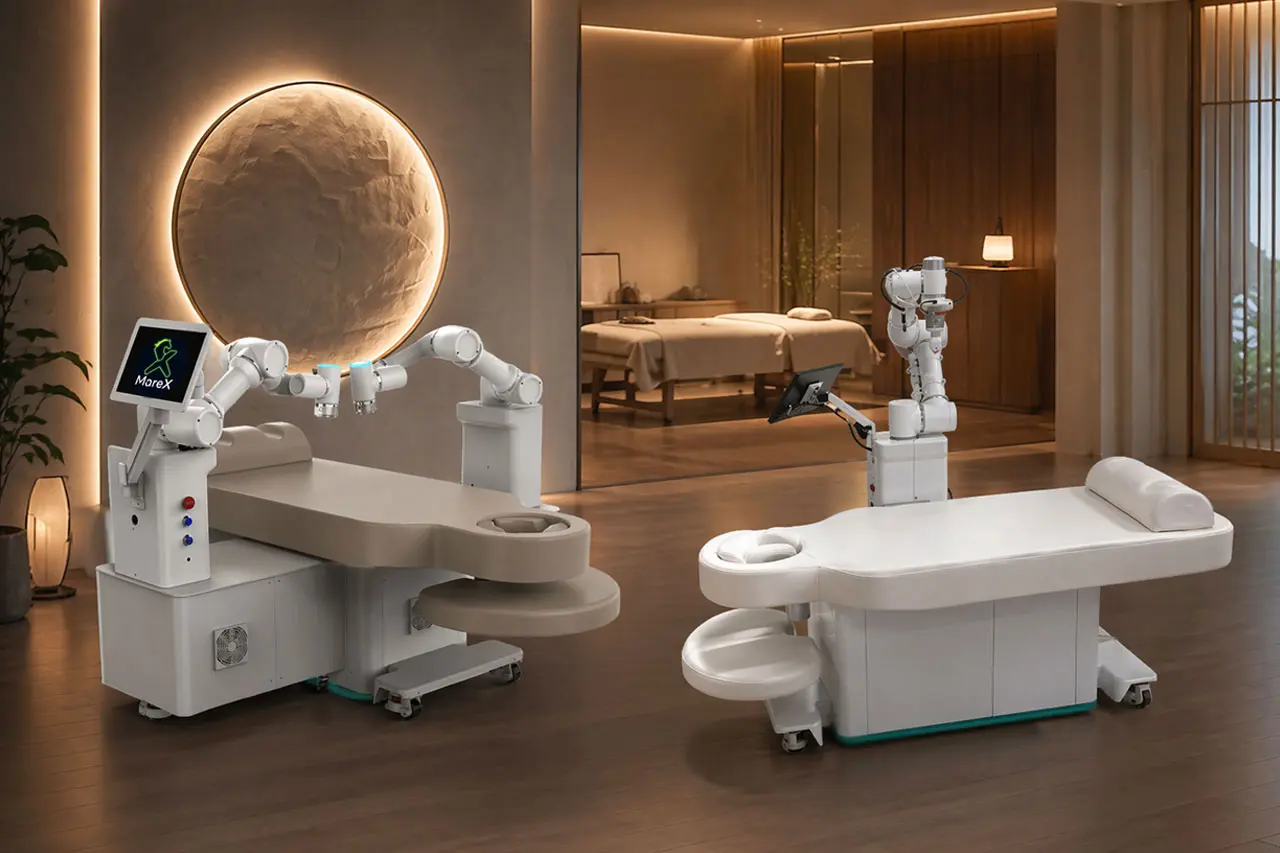
For wellness brands, spas, and other rehabilitation and physiotherapy establishments, choosing to invest in a customized body massage machine is a great opportunity. The correct choice can offer a business many benefits, including increased operational efficiency and enhanced customer satisfaction. Additionally, purposefully selected equipment can help build and promote the brand. While the equipment selected can offer many positive benefits to the brand, the key factor is selecting the correct, customized body massage machine manufacturer.

Manufacturers do not all have the same capabilities, quality control, or provide the same level of after-sales support. Making the correct choice can help identify a manufacturing partner and avoid a poor choice.

The following guide is meant to help all buyers with the most relevant questions to consider.

1. Is Customization Truly Offered by the Manufacturer?

A basic offering, like a logo print or color change, may be the only truly customized product offered by a manufacturer that claims to offer customized products.

A professional manufacturer of customized body massage machines should provide:

  • OEM and ODM services
  • Branding and UI customization
  • Software and packaging customization
  • Custom hardware with added business features

2. How Experienced is the Manufacturer?

Experience is important when developing smart wellness products.

When considering a manufacturer, keep these questions in mind:

  • How long have they been producing massage equipment?
  • Are they focused on AI massage tech?
  • Have they had any international OEM/ODM dealings?
  • What is their customer base?

Years in the business point to a greater understanding of product quality and the commercial and global regulatory aspects of business.

3. What Technologies Are Used in the Machine?

Compared to the traditional massage chair, modern massage equipment is high-tech.

Some features of state-of-the-art, highly individualized, automated massage systems are:

  • AI Body Map
  • Intelligent Body Scan
  • Robotic Massage
  • Dynamic Massage Pressure
  • Smart Massage
  • Voice Control
  • Safety Monitor

Advanced tech allows a higher degree of satisfaction with a massage and provides greater consistency and comfort.

4. How Does the Manufacturer Ensure Product Quality?

Product quality and satisfaction are highly dependent on quality control.

Manufacturing standards, inspection, and testing of:

  • Parts
  • Performance
  • Factory systems
  • Quality management
  • Product certifications

Quality manufacturers do multiple quality inspections during production, as opposed to the only inspection taking place before shipping.

5. Can the Machine Be Customized for Different Industries?

Knowing the varying needs of different industries is important:

  • Luxury hotels may need a system to provide a premium experience.
  • Therapeutic massage programs may be a requisite in physiotherapy clinics.
  • Relaxation is the goal in wellness centers, while rehabilitation facilities may need specialized features.

Customization may be extensive, but a quality manufacturer will expect and be able to suggest these variations.

6. What Safety Features Are Included?

Safety is a chief concern, especially with massage systems.

Inquire if the machine has:

  • Emergency stop buttons
  • Intelligent body detection
  • Pressure monitoring
  • Collision prevention
  • Automatic force adjustment
  • Safety algorithms
  • Real-time system monitoring

The equipment should have all the features above to ensure the safety of the users and operators and to give confidence to the operators.

7. Does the Manufacturer Provide OEM and ODM Services?

Many companies are interested in producing goods that they can sell under their own brand.

Inquire if the manufacturer offers:

  • Private labeling
  • Custom branding
  • Product design support
  • Software localization
  • Custom packaging
  • Marketing assistance
  • Technical documentation

The presence of OEM and ODM services on the market allows you to gain greater freedom to establish your own brand, as it is not necessary to have your own factory.

8. What After-Sales Support Is Available?

The purchase of a massage machine is only the first step in the commercial relationship.

A factory that constructs massage machines should provide the following:

  • Technical support
  • Warranty
  • Spare parts
  • Software updates
  • Help with installation
  • Training for operators
  • Maintenance assistance

High-quality after-sales services minimize downtime and support your investment.

Why Businesses Choose MareX

Customization at MareX goes beyond estheticism. We create smart massage solutions, tailored to your business.

Our tailor-made AI massage solutions comprise:

  • OEM and ODM Production
  • AI massage technology
  • Intelligent Body Recognition
  • Robotic Precision Massage
  • A variety of therapies
  • Commercial durability
  • Controlled quality production
  • International export assistance
  • Skilled personnel support
  • Tailored branding

Whether you are developing your own wellness brand or improving your line of commercial massage equipment, MareX provides a portfolio of customized solutions that are meant to foster business development.

Final Thoughts

Technology, quality, customization, safety, and support are all factors to consider when choosing a manufacturer for customized body massage machines. They will all help you select the right production partner in order to fulfill your needs now and in the times to come.

When looking for a massage machine manufacturer, don’t only consider the cost. The manufacturer’s engineering capabilities, standards for quality, and their ability to provide tailored solutions will also be important factors to keep in mind. A good manufacturing partner will be able to provide you with an equipment investment that is successful, reliable, and performs well.

Frequently Asked Questions (FAQs)

1. What is a customized body massage machine?

It is massage equipment that can be tailored to the client’s business needs by customizing the branding, software, hardware, the user interface, or the therapy options.

2. Why should I choose a customized body massage machine manufacturer over a reseller?

Manufacturers are able to guarantee superior quality, customization, pricing, and OEM/ODM and technical support, all of which are important for forming a long-term business relationship.

3. Who uses custom body massage machines?

Custom body massage machines are found at wellness centers, spas, hotels, rehab clinics, physiotherapy centers, gyms, healthcare, and commercial wellness businesses.

4. What are the available options for customization?

Common customization options include private label, logo, software, and language. Customers may also request changes to packaging, hardware, therapy programs, and color.

5. What defines a trustworthy manufacturer?

Experience, high-tech equipment, expertise in quality control, good OEM/ODM capabilities, international export capabilities, product certifications, and good after-sales service.

6. Are MareX’s services OEM and ODM?

Yes. MareX provides both OEM and ODM for companies designing custom AI massage equipment under their brand with their business operations.
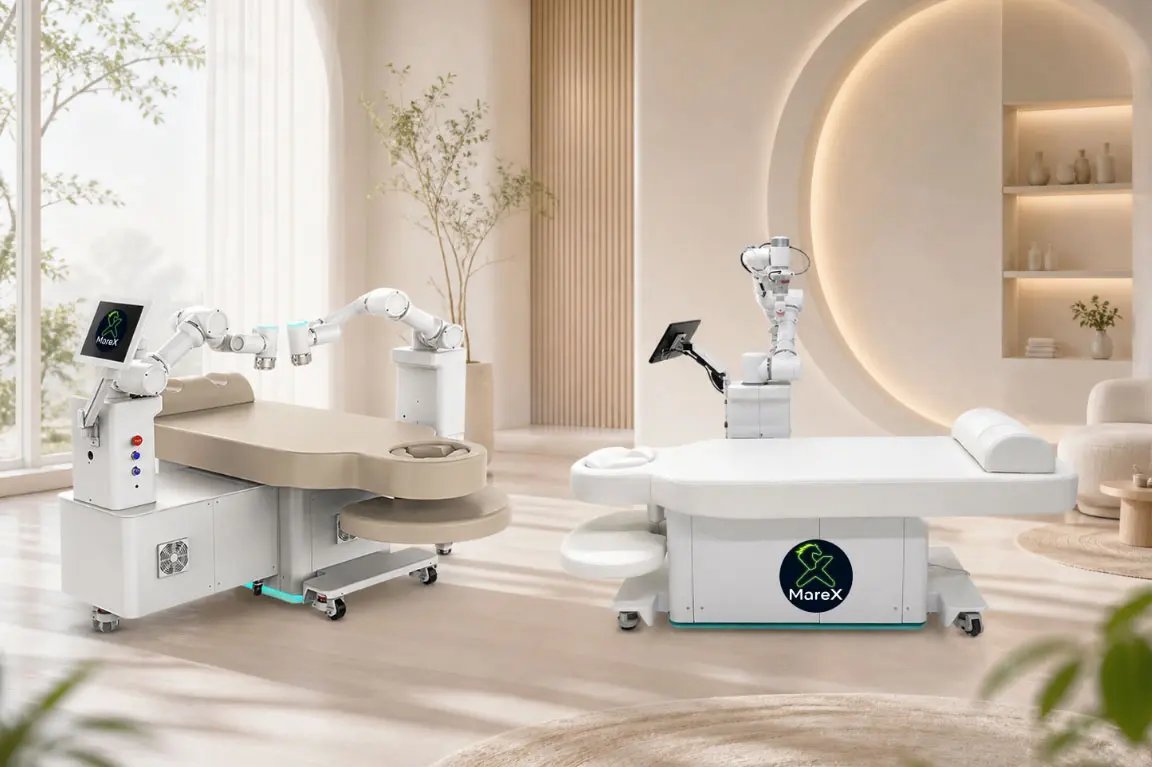
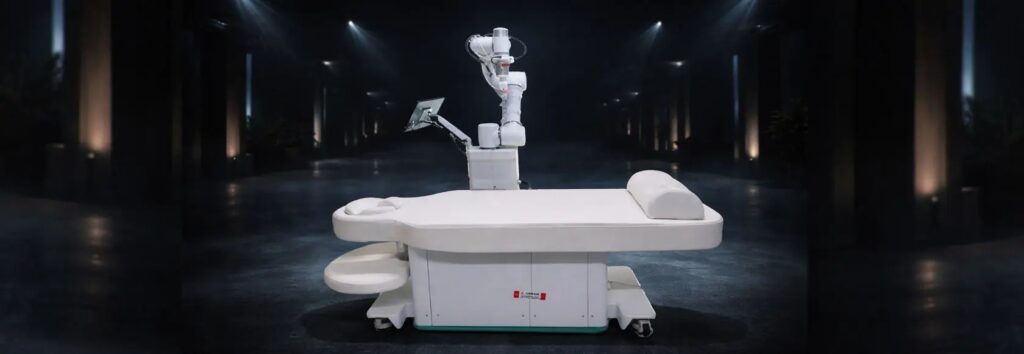
AI Massage Robot vs Traditional Massage Chair: Which Is Better in 2026?

Massage therapy has always had a human element. Now, that is changing.The massage chair was engineered to service the demand for affordable, portable convenience. This mechanical solution was so effective that it never really occurred to consumers that they might benefit more from a visit to a trained professional. The massage chair quickly filled the gaps left by therapists, finding a home at airports and shopping centers around the world. Until the 2020s, there was little innovation to compete with the massage chair. Then the AI wellness revolution began.

Now, you have the option for intelligently robotic systems that do more than follow a programmed routine. Like a trained professional, they can sense, adapt, and respond to your body at that particular moment. They can be found across the globe in spas, clinics, and hotels.

What Is a Traditional Massage Chair?

Background & Technology

The history of the conventional massage chair is longer than many think. In the 1950s, the first version of this chair rolled and kneaded like a hand. As time passed, manufacturers expanded the technology with air bags, vibro-stimulation, and warmth therapy. All of these attributes began to include equipment relaxation.

From the 1990s to the 2000s, massage chairs advanced to the point of allowing users to select automated versions of styles that included shiatsu, Swedish, and rolling. All a user had to do was press a button and let the chair do the work.

This type of convenience does come with a major flaw. The automated functions of a massage chair are entirely regimented. The motors, rollers, and mechanisms used for inflation are all set to function in an identical way. It doesn’t matter if you are one of the strongest athletes in the world or have an office job with an entirely sedentary lifestyle; you are still going to experience the same automated massage.

The standard massage chair is easy to sell because they are relatively cheap and do have utilitarian value. For private home users or even wellness lounges that are just starting up, they are reasonable to sell. The cost does come with just as limited flexibility and no real-time muscle feedback, which leaves the same routine for every session.

What Is an AI Massage Robot?

Background & Technology

Unlike any other technologies, AI massage robots emerged from the integration of industrial robotics, artificial intelligence, and medical-grade sensor engineering. Not only do they simulate massage, but they intelligently perform the task.

Modern AI massage robots utilize 6-axis force sensors that measure muscle tension and resistance, and track the movement and position of the body, in real time. During the massage, the AI uses real time sensor data to alter the force and speed of the robotic arm, as well as the angle and type of the massage, all in a matter of milliseconds.

This intelligent robotic system uses arm mechanics, AI, and sensors, which ensure safety and precision, to perform adaptive, and ultimately, personalized therapy. As a result, each massage is drastically different from the others.

AI massage robots offer deep tissue, sports recovery, neck and shoulder therapy, pressure-point therapy, and massage relaxation therapy. They are utilized in professional spa centers, physical therapy clinics, luxury hotels, corporate wellness locations, and physiotherapy centers.

Technology Comparison Table 

Feature AI Massage Robot Traditional Massage Chair 
Core Technology Robotic arm + AI algorithms + sensors Motors + airbags + mechanical rollers 
Personalization Real-time body adaptation Fixed pre-set programs 
Massage Styles 7+ therapy types 3–4 basic modes 
Hygiene Minimal human contact, easy-clean surfaces Surface-level cleaning only 
Consistency Always same quality, every session Varies only by setting 
Use Cases Commercial, clinical, and hospitality Home use mainly 
Customization (OEM/ODM)   full OEM/ODM solutions No 
Automated Massage Robot Fully automated with AI decision-making Decision-making Partially automated with fixed routines 
Cost Higher upfront, significantly better long-term ROI Lower upfront, limited ROI 
Safety Features Emergency stop, pressure monitoring, smart force limits Basic mechanical safety only 

Head-to-Head Comparison

Personalization

It is not a close race. This is by far the largest difference between the two technologies.

Most people have used or seen a traditional massage chair at some point  in a shopping mall, an airport lounge, or a home wellness corner. Despite how familiar they feel, every traditional massage chair shares the same core limitation. It does not know if your lower back is under strain or if your shoulders are carrying tension. It cannot sense the difference between a fully relaxed muscle and one that is severely knotted. From the moment you press start to the moment the session ends, it runs the exact same pre-programmed routine — for every person, every time, without a single adjustment.

With the smart massage robot, your experience will be the total opposite. AI technology relies on real-time data collection and recording. The AI robot is able to record and read your muscle’s resistance and tension with the help of 6-axis force sensors while the massage is taking place. If the AI massage robot senses that your left shoulder is tight, it will apply more pressure to that shoulder and adjust its massage techniques accordingly. If it is to massage a more sensitive area of your body, it will take an even lighter approach. The end result from the AI massage robot is a personalized massage that actually targets your body.

Consistency

Consistency might not concern the average home user, but it is crucial for businesses that provide massage services.

Even the best therapists are inconsistent, and the variance is even greater when considering different therapists. Clients can tell the difference between receiving an amazing massage one week and one that is subpar the following week, and clients might not return.

An AI massage robot will provide just as good of a session for the five hundredth time as it will for the first time. Robots don’t tire, don’t take off days, and don’t alter their methods. For a spa or wellness center that is trying to build a name for themselves around providing consistent quality services, having a massage robot is more of an advantage than having a traditional massage chair.

Technology Depth

The gap in technology between these two products is massive.

A standard massage chair relies on basic electrical and mechanical systems. Motors are used drive rollers along a set path, airbags inflate and deflate on a timer, and heating elements warm predetermined zones. There is no variability in the script the system operates on.

Ai massage robot operate at an entirely different level. Robotic arms powered by precision torque sensors accommodate the user’s needs and input. AI makes real time decisions on pressure, movement, and technique. It also incorporates smart body detection systems, meaning the robot is aware of the exact position of the user’s body at any given time. This technology does not sit in the same category as upgraded massage chairs.

Hygiene

Compared to their predecessors, consumers in the post-pandemic world have a greater focus on hygiene, and this is where AI massage robots clearly excel.

It can be hard to sanitize traditional massage chairs since they have fabric surfaces, padded cushions, and enclosed headrest. AI massage robots, however, are built to ensure clinical hygiene. These robots require minimal direct human contact, are built with smooth and easy-to-clean surfaces, and sanitize themselves after each use.

Cost

It’s no secret that a standard massage chair is cheaper. You can find all the basic massage chair designs at a much lower price than the first-tier commercial massage AI Robots.

However, your calculations for long-term business value alter the entire situation. An AI massage Robot provides spas and wellness centers the ability to serve more clients with fewer therapists and increase the price of the service experience, resulting in the creation of long-term client loyalty. In 12 to 24 months of operation, the return on investment from an AI robotic massage system outperforms the savings of the cheaper upfront alternatives.

For the personal at-home user on a budget, that simple chair will work well enough. But for a business considering long-term growth, the AI Massage Robot is a far more intelligent investment.

Business Scalability

Traditional massage chairs are limited by unit economics: they are used by one person at a time, do not allow customization, and cannot be part of a clinical workflow. Additionally, they cannot be tailored for various market segments.

AI massage robot manufacturers can be designed for mass production. They can be used in multiple rooms, integrated with OEM and ODM branding, have different software interfaces, and be adjusted for various markets: you can design one for the luxury hospitality market in the USA, the physiotherapy market in Germany, or even the corporate wellness market in the UK.

Who Should Choose What?

Choose a Traditional Massage Chair If:

  • You need an affordable personal wellness device for home use
  • You want a simple, low-maintenance solution with no technical complexity
  • You are an individual user with no plans to offer massage as a service
  • Your budget does not currently support a commercial-grade investment

Choose an AI Massage Robot If:

  • You operate a spa, hotel, clinic, fitness center, or corporate wellness facility
  • You want to scale your massage services
  • You need massage robot OEM or ODM branded solutions to build your own wellness product line 
  • You serve high volumes of diverse clients who expect consistent, premium quality
  • You are investing in long-term operational efficiency and service differentiation

 FAQ:-

1.What is the main difference between an AI massage robot and a traditional massage chair?

The difference is in the adaptability and intelligence. Typical massage chairs are built to follow the same routines. They cannot adapt to the person using them. Massage chairs with embedded AI analyze the user in real-time by gauging touch, muscle tautness, and body posture to modify the pressure, speed, and technique to create a custom experience. 

2. Can AI massage robots be customized for my brand or business?

Yes. With OEM and ODM manufacturing options, companies can choose how to customize every aspect of their AI massage robot, from branding and configuration of the robotic systems, to designing the software interfaces and even the design of the product itself. This customization allows wellness companies to offer a massage robot product that is specifically tailored to meet the needs of their target market and clients. 

3.What massage therapy styles can an AI massage robot perform?

AI massage robots offer a range of therapeutic techniques including deep tissue massage, relaxation massage, sports recovery massage, neck and shoulder therapy, back muscle recovery, pressure point therapy, and adaptive health routines with real-time and body specific adjustments. 

4.. How do I choose the right AI massage robot for my business?

Several factors should be evaluated when considering the application of an AI massage robot in a commercial business. These include the depth of the AI functions and the sensors, the ability for the robot to perform multiple types of massage with precision, available built in safety elements, and the extent of personalization and OEM/ODM support, the standing of the builder in the market and quality of after sales services, and terms of the warranty. Engaging with a proficient AI massage robot builder allows the customer to attain a solution tailored to the specific needs of the customer business. 

5..Which industries are investing most in AI massage robots?

Professional spas and wellness centers, luxury hotels and resorts, physical therapy and rehabilitation clinics, corporate wellness spaces, sports recovery and fitness centers, and smart home wellness environments are the sectors attracting the most investment in AI massage robots. 

6..Are AI massage robots hygienic for shared commercial use?

Definitely. Artificially intelligent massage robots are constructed with clinical hygiene in consideration. Due to their flexible, cleanable surfaces and reduced contact with humans, they are much easier to sanitize in comparison to conventional massage chairs. Traditional massage chairs are constructed with cushions and fabric surfaces which are difficult to clean. 

7..Is an AI massage robot safe to use every day?

Yes. The majority of AI massage robots are designed for routine daily use. They include safety measures such as emergency stop buttons, intelligent pressure systems, automated adjustments of force limits, and body detection systems. These systems impede potentially harmful pressure from being applied at any time during the session. 

Conclusion

In 2026, both technologies have a place, but neither are for the same audience.

For personal use massage chairs are affordable, budget-friendly, traditional options. They serve their purpose, are easy to use, and don’t require a lot of money or knowledge.

But in the professional wellness spaces (spas, clinics, hotels, physiotherapy space, corporate wellness space), the AI massage robot wins. Better and smarter personalization ability, constant output, improved hygiene, and smart technologies with a strong long-term ROI make it the only option for companies wanting to grow, differentiate themselves, and offer exceptional premium large-scale client experiences.